In 2007, Californian voters narrowly passed a bill that would allocate nearly $10 Billion to build a high-speed train system between San Francisco and Los Angeles, with eventual connections to the Sacramento and San Diego areas. The project has stalled, and as of 2026, 104 of the planned 776 miles of guideway have begun or completed construction. As it stands, the California High-Speed Rail Authority claims that an early line between Merced and Bakersfield will open in 2033, but critics are skeptical.
Republicans both locally and nationally have expressed strong opposition towards the project. Former House Speaker and Bakersfield native Kevin McCarthy infamously claimed that he’d “do whatever I can to ensure that not one dollar of federal funds is directed to this project” in 2014. President Donald Trump has followed suit, with him specifically taking action against the project in both his first and second terms, notably pulling almost $4 billlon of federal funding in July 2025.
Voters believed in the project because of the idea of a cheaper, more comfortable, more energy efficient way to travel. But what separates CA-HSR from other rail projects like Amtrak Acela or Florida's Brightline, and what makes it viable as a flying alternative is the promise of a ride from San Francisco to Los Angeles in less than 3 hours. This would make it comparable to French TGV trains or Japanese Shinkasen.
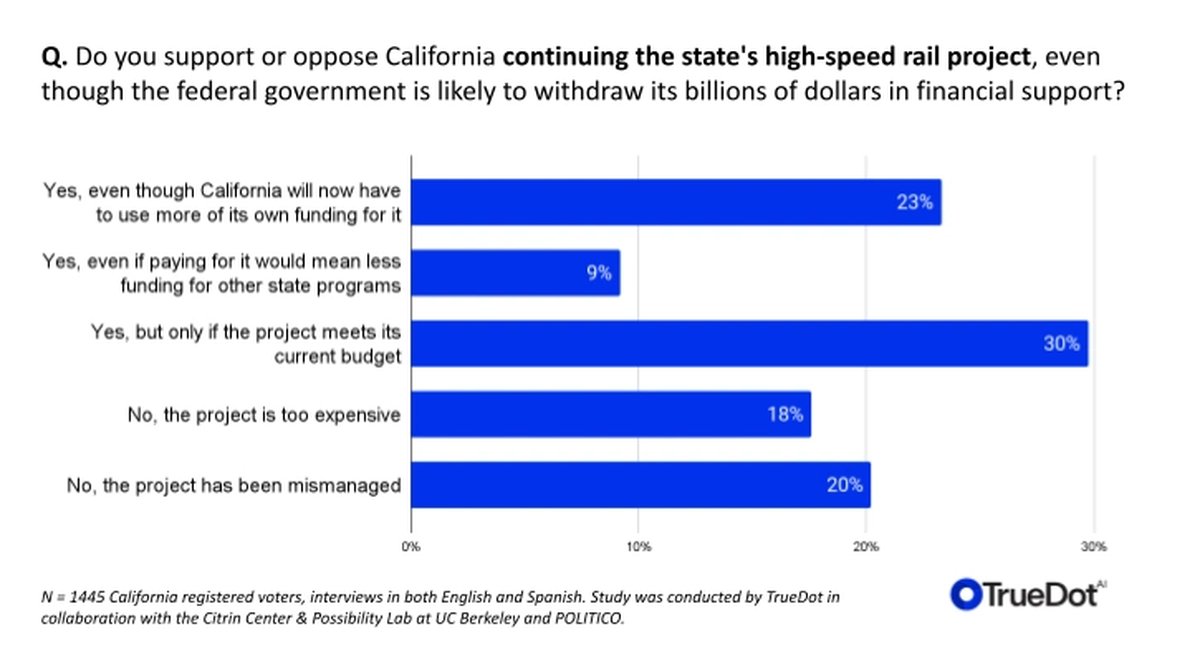
But despite CA-HSR’s seeming failures and the GOP’s harsh opposition, according to a recent poll from Politico, most registered California voters are still in favor of continuing the project. When asked if they “support or oppose California continuing the state's high-speed rail project, even though the federal government is likely to withdraw its billions of dollars in financial support”, 23% of respondents said yes, even if it meant that the state would have to use more of its own funding for it. 62% of voters supported it in some way, including 79% of Gen Z voters, 79% of Democratic voters, 55% of Independents, 91% of voters who believe the project is likely to happen, and even 48% of voters who believe that high-speed rail is “unlikely”. On the other hand, 52% of Boomers opposed the project due to it either being “too expensive” or “poorly managed.” 62% of registered Republicans opposed the project for the same reasons.
The 2026 Gubernatorial Election could be a turning point in the project’s construction. Chad Bianco and Steve Hilton, both Republicans and the current leader and third placed candidate according to the New York Times aggregator's most recent polling, are both vocal critics of the project. Bianco, in particular, called it a “train to nowhere” and called for “end(ing) this thing right now.” If Bianco wants to capitalize on independent and center-left Democrats frustrated with Newsom, then it could be advantageous to break party lines and change his policy.