
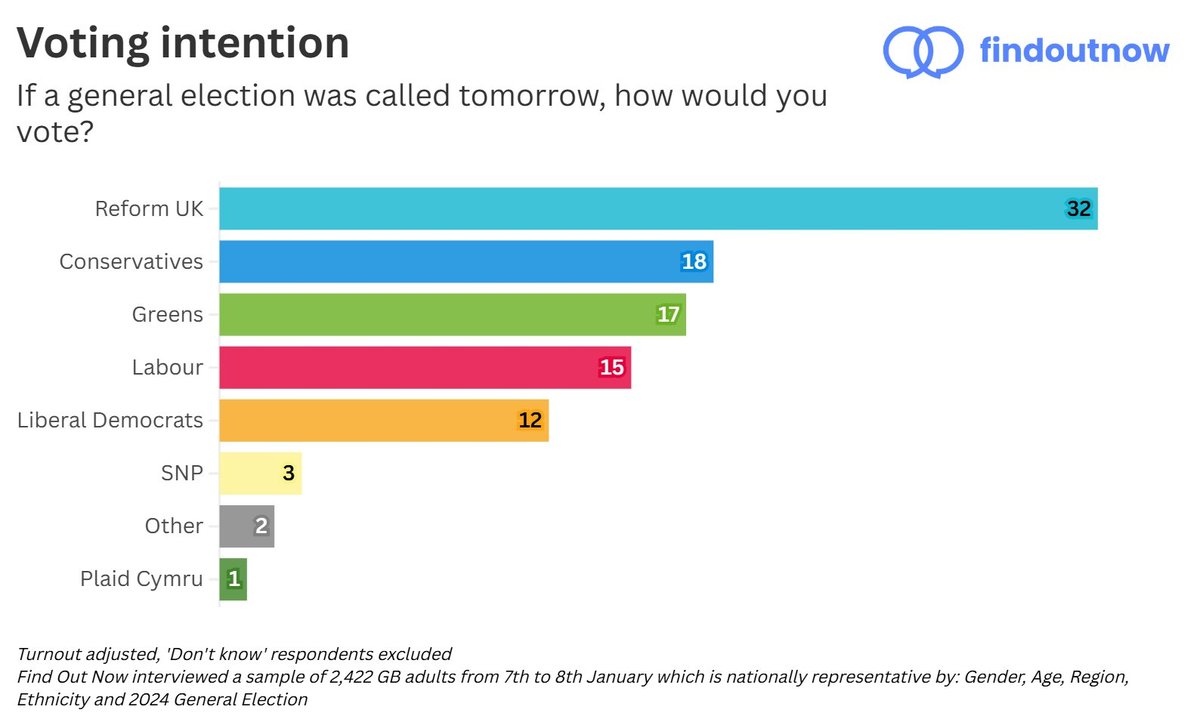
A new poll from findoutnow reveals that if a general election were held in the UK tomorrow, Nigel Farage’s Reform UK would likely win the most votes. While the poll does not predict seat outcomes, it highlights a broader pattern of voter dissatisfaction with the two major parties that have dominated British politics for much of the past century.
For almost 20 years, UK voters have largely been disillusioned with their government. The last time a Prime Minister ended his or her term with a positive approval rating was after the resignation of Tony Blair in 2007. Since his departure, the Conservative party has dominated parliament, largely due to Labour’s internal instability. Despite the fact that the Tories have been at 10 Downing Street for more than 75% of the time since Blair’s resignation, most of their leaders have recorded sustained negative approval ratings with the brief exception of David Cameron before the Brexit vote. Theresa May, Boris Johnson, Liz Truss, and Rishi Sunak all faced persistent negative press and low favorability ratings among British voters. These leaders were perceived to be out of touch and their failures to successfully address key issues such as immigration, affordability and taxes further damaged their standing with voters. Immigration, in particular, has been a key area of public debate. Supporters of stricter immigration controls argue that high net migration places pressure on housing, wages, and public services. Critics counter that immigration contributes to economic growth, addresses labor shortages, encourages cultural exchange, and offsets demographic decline.
In 2024, British voters ousted the Conservatives by giving Keir Starmer and the Labour Party a large parliamentary majority, allowing the party to form a government without support from either the Conservatives or the Liberal Democrats. But not even a year and a half into Starmer’s term, his government has been marked by scandals and a general perception that it is inefficient and weak. According to YouGov UK on December 28, 2025, only 15 percent of respondents said that Keir Starmer is “doing well” as PM, while a large majority (73 percent) of respondents said he is “doing badly.” It’s worth noting that on August 25th, 2024, less than two months after his appointment, that same poll showed 43 percent of respondents already believed he was doing badly (compared to 36 percent who believed he was doing well).
Starmer (and his predecessors) failure to tackle critical issues has given rise to a new form of right wing populism led by former Member of European parliament Nigel Farage. Since promising and delivering on Brexit, (when the United Kingdom left the EU) he has been a relatively controversial figure in the UK. Young voters who have only known unpopular and uncharismatic leaders, appear particularly receptive to Farage’s anti-establishment messaging. Polls also suggest that he is successfully appealing to working class middle-aged and older men, many of whom come from Northern families that had loyally supported Labour for multiple generations.
Reform UK’s rise has placed Farage at the center of speculation about future political leadership. His policy positioning has drawn comparisons to Donald Trump’s 2016 campaign, focusing on reducing net immigration and deporting undocumented lawbreakers. Economically, he’s a right wing populist, pushing for lower taxes as well as a lower cost of living. The parallels to Trump's 2016 campaign are striking, especially with respect to Farage's media strategy. He relies on virality and his personal charisma to generate social media clips and popularity.
In Reform UK’s manifesto, the party states: “Both Labour and Tory governments have broken promise after promise. They have destroyed trust in our democracy and betrayed the British people.” While many initially saw Farage as the future leader of the Conservative Party, the popularity and attitudes of his party suggest that he can create a third option to the unpopular Labour vs. Conservative two-party-system. Other parties have also attempted to capitalize on voter dissatisfaction. Left-wing Green Party co-leader Zach Polanski has argued that the Greens should be viewed not as a supplementary force to Labour, but as an alternative political home for disillusioned voters.
Overall, the deteriorating political climate of 2010s Britain and Labour’s inability to capitalize on the chance they were given in 2024 have both contributed to Reform’s surge in the polls. Despite controversy surrounding Farage's rhetoric and policy positions, polling indicates Reform UK is currently one of the strongest contenders heading into the next UK general election.